
Top Signs You Need Garage Door Service – Don’t Ignore These
The clearest signs you need garage door service are a door that moves unevenly, a grinding sound that wasn’t there last season, a remote that lags even with fresh batteries, or a visible gap in the spring. A door that takes two seconds longer to open than it did last spring isn’t being dramatic, it’s telling you the spring tension is off, and in most cases that spring has already lost a chunk of its cycle life. Warning signs don’t appear all at once. They stack up in order, and reading them in the right sequence tells you whether you have weeks or months before something fails. If you’d rather not climb a ladder to check, call (855) 550-7498 and we’ll take a look.
Key Takeaways
- Garage door failures follow a predictable arc: early quirks, then visible wear, then hard stop.
- Asymmetrical movement and faint grinding are the earliest signals most homeowners dismiss.
- Frayed cables, roller wear tracks and inconsistent auto-reverse mean a component is weeks from failing.
- A visible spring gap, one-sided sag or a burning smell from the opener means stop using the door and call same day.
- The balance test is the one safe monthly check that gives you real data on where your door sits in that arc.
What are the early warning signs of garage door trouble in Glen Burnie?
Early warning signs are the ones homeowners shrug off: the door drifts slightly to one side as it rises, a faint grinding hums along the track, or the remote takes an extra press to respond even with a new battery. None of these stop the door. All of them mean a component has started to wear. In Glen Burnie, humidity spikes in summer and freeze-thaw cycles in winter work on metal and lubricant in ways that speed up that wear, so a quirk that shows up in July often gets worse by the first cold snap.
Here’s what to listen and watch for at this stage:
- Asymmetrical movement. One side of the door rises faster than the other. That usually points to uneven spring tension or a roller that’s binding.
- Faint grinding during travel. A dry or worn roller grinding on the rail. It’s quiet now; it gets louder as the roller flattens.
- Remote lag that isn’t the battery. If a fresh battery doesn’t fix a sluggish remote, the opener’s logic board or receiver is the next suspect. We handle garage door opener repair on Genie and LiftMaster systems regularly, and a slow-response opener is one of the most common calls we get.
- A door that feels heavier by hand. If lifting the door manually (with the opener disconnected) takes more effort than it used to, the springs are losing tension.
At this stage the fix is usually small: a roller swap, a lubricated track, a spring adjustment. Waiting is what turns a small job into a spring replacement.
Which mid-stage signs mean a part is weeks from failing?
Mid-stage signs are the ones that mean a component is weeks, not years, from giving out. This is where the door still works but the margin for error has shrunk to almost nothing. Three signals stand out, and each one points to a specific part on the way out.
- Visible cable fraying. Look at the cables running along the sides of the door. Frayed strands or a fuzzy look near the drum mean the cable is under strain and could snap. A snapped cable is a safety issue, not just an inconvenience.
- Roller wear tracks on the inside rail. If you can see a groove worn into the inside of the track, the roller has been dragging for a while. That wear transfers stress to the hinges and the opener.
- Inconsistent auto-reverse. The safety reverse should stop and raise the door every time something blocks it. If it works one day and not the next, the opener’s sensitivity settings or the safety sensors need attention. A door that doesn’t reliably reverse is a genuine hazard, especially with kids or pets in the driveway.
In Glen Burnie, we see mid-stage wear show up fastest on doors facing direct afternoon sun, because the heat cycles on the panels and the opener motor compound the mechanical wear from the humidity. Brands like Clopay and Amarr hold up well, but no door escapes the cycle entirely. Mid-stage is the window where a repair saves you a replacement, so it pays to get someone out to look rather than waiting for the door to fail outright.
What late-stage signs mean you should stop using the door today?
Late-stage signs mean stop using the door and call for same-day service. These aren’t quirks anymore. They’re a component that has already failed or is about to, and every cycle you run puts more load on the rest of the system.
- A visible spring gap. If you can see a gap in the torsion spring above the door, the spring has broken. Do not run the door, and do not try to lift it by hand. A broken torsion spring releases an enormous amount of stored energy, and the cable and drum are the only things holding the door’s weight. This is the one component we never advise a homeowner to touch. Spring work is a trained-professional job, full stop, and it’s why we list garage door spring repair as its own named service rather than folding it into general repair.
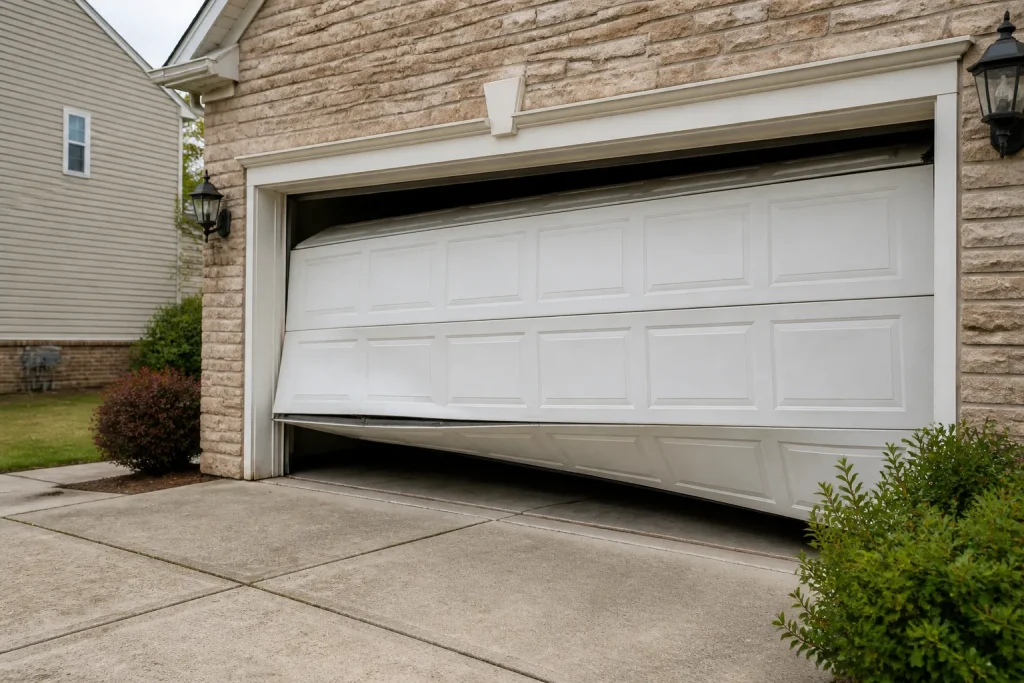
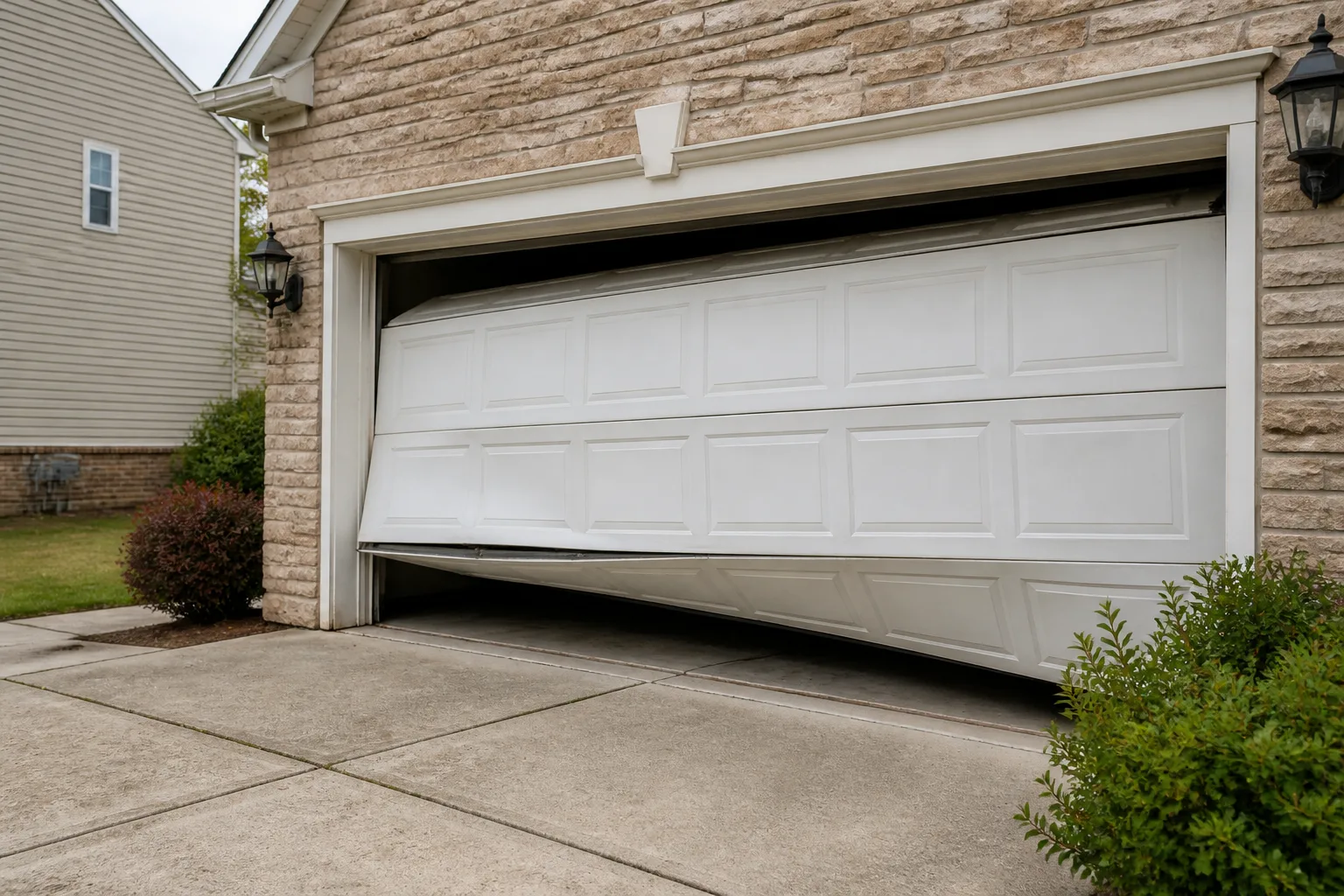
- The door sagging on one side when stopped mid-travel. Stop the door halfway and look at it. If one corner sits lower than the other, a cable or spring is out of balance. Running it like this can bend the panels or twist the track.
- A burning smell from the opener. That smell means the motor is overheating or wiring is stressed. Unplug the opener and leave it off until someone checks it.
Any of these three is a same-day call. Don’t force the door open or closed by hand, and don’t let anyone stand under it.
How does Glen Burnie’s climate speed up garage door wear?
Glen Burnie’s climate shortens the failure timeline compared with drier parts of the country. Humidity spikes in summer, freeze-thaw cycles in winter, and the general dampness of the region work together on the parts that move. In a dry climate a roller might last years with little attention; here the same roller can start to bind within a couple of seasons.
The mechanics are simple. Summer humidity rusts the steel track and thins the lubricant on the rollers and hinges, so metal starts grinding on metal earlier than it should. Then winter freeze-thaw cycles swell and shrink the wood or steel around the door opening, which can knock a track out of alignment and put uneven strain on the springs. When spring and fall bring big temperature swings, the opener motor cycles through hot and cold, and its gears and logic board feel it. A damp, freezing cycle isn’t dramatic, but it’s relentless, and it’s why we tell Glen Burnie homeowners to do their monthly balance check rather than an annual one.
Brands matter less than maintenance here. A Wayne Dalton door and a Clopay door both lose tension over time; the difference is how often someone looks. We work on both, plus Genie and Chamberlain openers, and the story is the same across all of them: small wear gets caught early or it grows into a spring or opener failure.
What’s the one safe monthly check homeowners can do?
The balance test is the one check you can do safely every month, and it tells you more about your door’s health than anything else. It takes about two minutes and gives you real data on where the door sits in its failure arc, without touching the springs or cables.
- Close the door and pull the opener’s release handle to disconnect it from the door.
- Lift the door by hand to about waist height and let go.
- Watch what happens. A healthy door stays put where you leave it. A door that drifts down on its own, or rises on its own, is out of balance.
If it drifts, note which way and how fast. A slow drift is an early-stage sign worth a look; a door that slams down has a spring problem and needs a same-day call. Reconnect the opener afterward and run the door once to confirm it’s engaged. That’s it. No tools, no ladder, no risk. Do this once a month and you’ll catch spring wear before it becomes a broken spring.
When to call a pro
Call a professional if the door is out of balance, if you see frayed cables, or if you hear grinding that won’t go away. Anything involving the springs, cables or the opener’s internal wiring is a job for someone trained on it. These parts hold serious tension and store real energy, and the wrong move can injure you. Our technicians have up to 8 years of experience and work only on garage doors, which means fast diagnosis and the right parts, not guesswork.
Related services in Glen Burnie: for a full range of fixes, see our garage door repair page, or start at Glen Burnie Garage Door Repair Pros to find the right service for your door.
The Bottom Line
Garage door failures don’t happen out of nowhere. They move through stages: early quirks like a drifting door or a lagging remote, mid-stage warnings like frayed cables and inconsistent auto-reverse, and late-stage emergencies like a visible spring gap or a burning smell. Catch the early and mid-stage signs and you’re looking at a small repair. Ignore them and you’re looking at a same-day emergency, usually at the worst possible time. The monthly balance test is your cheapest insurance. Run it, note the result, and call when something changes. If you’re in Glen Burnie and need help, Glen Burnie Garage Door Repair Pros offers free estimates. Call (855) 550-7498. We answer 24/7. Fast dispatch from 7am to 7pm, Sunday through Friday. Whether it’s a grinding roller or a snapped spring, one call handles it.
Frequently Asked Questions
The first signs are asymmetrical movement, faint grinding during travel, and a remote that lags even with a fresh battery. These are early-stage signals that a component has started to wear. They don’t stop the door yet, but they mark the start of the failure arc. Catch them early and the fix is usually small. Call (855) 550-7498 for a free estimate.
No. A torsion spring holds the entire weight of the door under extreme tension, and a mistake can cause serious injury. A broken spring is a trained-professional job, and we recommend keeping everyone clear of the door until someone qualified looks at it. Our spring repair is a named service for exactly this reason. Call (855) 550-7498 and we’ll take it from there.
Once a month. The balance test is the one safe check you can do regularly, and it gives you real data on whether your springs are holding tension. A door that drifts down or up on its own is out of balance and needs attention. In Glen Burnie’s humidity and freeze-thaw climate, monthly is better than annual. Call (855) 550-7498 if your door fails the test.
Not always, but it’s worth a look. Faint grinding early on often means a dry or worn roller, which is a small fix. Grinding that gets louder and comes with a door that jerks or slows down points to a bigger problem with the track or opener. Don’t ignore it and hope it quiets down; it usually doesn’t. Call (855) 550-7498 for a free estimate.
Written by the team at Glen Burnie Garage Door Repair Pros.
Need Garage Door Help?
Call Glen Burnie Garage Door Repair Pros - the local pro we connect you with is licensed and insured, here with fast help in Glen Burnie.
(855) 550-7498