
Emergency Garage Door Repair Near Me: What Glen Burnie Homeowners Should Do First
The most common thing people do when a door comes off its tracks is try to force it back manually. That single mistake can bend the track, snap a cable, and turn a $180 repair into a $600 one. The five minutes after a garage door fails decide whether you’re dealing with a simple fix or a much bigger bill. Here’s how to handle those first five minutes in Glen Burnie without making things worse. If you’d rather not deal with it yourself, call (855) 550-7498 and we’ll take it from there.
What should you do in the first five minutes after a garage door fails?
Stop. Don’t touch the door, don’t hit the button again, and don’t grab the nearest tool. The first five minutes are about containing the problem, not fixing it. A garage door is one of the heaviest moving objects in your home, and under tension it can be genuinely dangerous.
Here’s the sequence that keeps you and your door safe:
- Step back and look. Is the door crooked in the opening? Is a cable hanging loose? Is the door resting on something? A visual check tells you what kind of failure you’re dealing with.
- Cut the power to the opener. Unplug it or flip the breaker. A door with a broken spring or a jumped cable shouldn’t be cycled again, and killing the power prevents anyone from pressing the remote out of habit.
- Keep people and cars clear. Don’t park under a door that’s hanging unevenly, and keep kids away from the opening. A door that comes down on its own is a real risk.
- Leave the door where it is unless it’s blocking your car and you’ve read the manual release section below.
- Gather the details you’ll need for the call, which we cover further down.
In our experience across Glen Burnie, the failures that turn into expensive repairs almost always involve someone trying to force a door back into place before they understand what broke. The door isn’t being stubborn. Something in the system has failed, and pushing harder doesn’t fix it.
Which garage door failures can wait until morning, and which can’t?
Some failures are an inconvenience you can sleep on. Others are a security or structural problem that needs attention now. Here’s how to tell them apart.
Safe to leave overnight
- The door is fully closed and locked. If the door is down, seated in the opening, and the opener just won’t lift it, you’re dealing with a mechanical or electrical issue, not a safety emergency.
- The opener runs but the door doesn’t move. Often a stripped gear or a disconnected trolley. Annoying, not urgent.
- A remote or wall button stops working. Usually a battery, a sensor alignment issue, or a logic board problem. Your door still closes by hand if needed.
- One section has a small dent with the door still operating normally.
Needs prompt service
- The door is stuck partway open. Your home is exposed, and the door is under load. This is the classic security emergency.
- A torsion spring has snapped. You’ll usually hear a loud bang and find a gap in the spring coil above the door. Never operate the door in this state.
- A cable is loose, frayed, or hanging. Cables are under extreme tension and can whip. Don’t touch them.
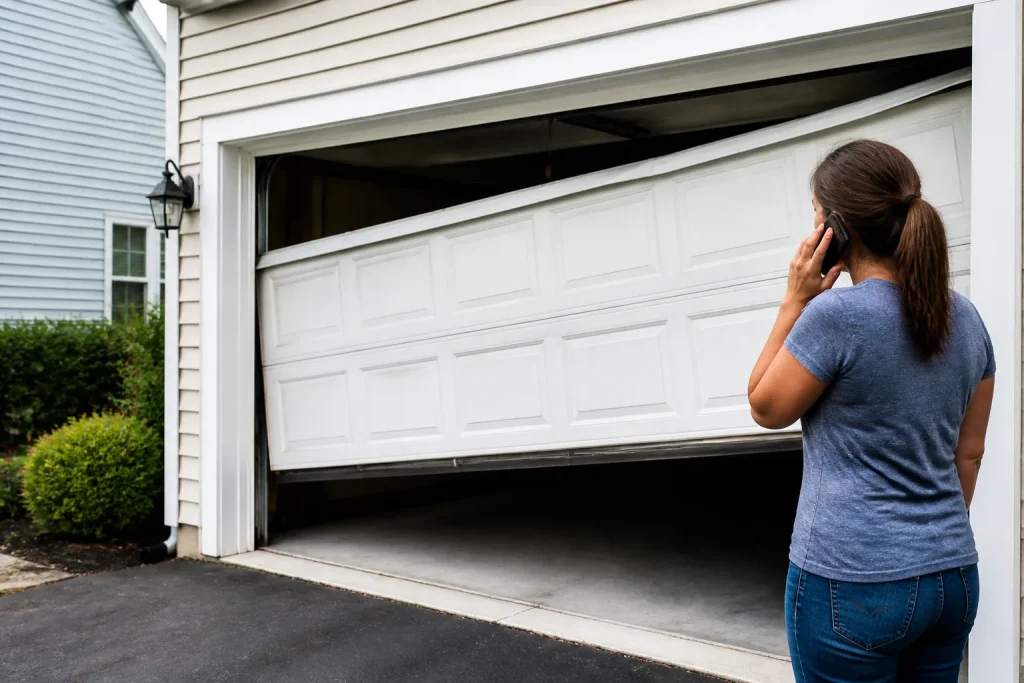
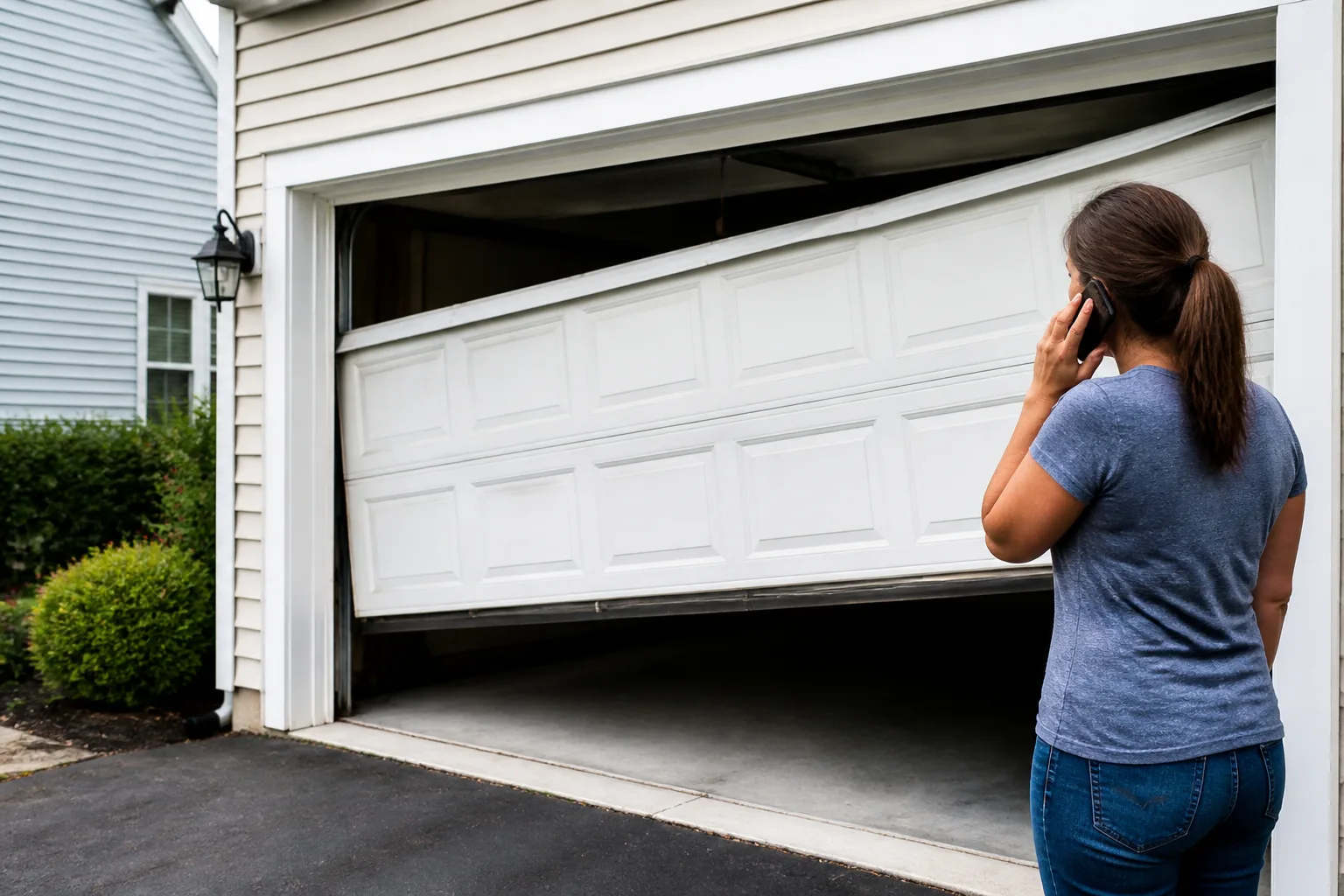
- The door is off its tracks or hanging crooked. Structural risk. Leave it alone.
- The door came down on something and the panels are buckled.
We answer 24/7, so a call at 2am gets a real person and a plan. Fast dispatch runs 7am to 7pm, Sunday through Friday.
How do you use the manual release cord without causing more damage?
The red release cord is the single most misunderstood part of a garage door. Pulled at the wrong moment, it can send a door crashing down or drop it on your car. Pulled correctly, it’s how you get your car out and carry on with your day.
Here’s how to do it right:
- Only pull the cord when the door is fully closed. If the door is up, pulling the release disconnects the opener and gravity takes over. That’s how doors come down hard on cars and people.
- Stand clear of the door’s path. Once you release it, the door becomes a free-hanging weight. Give it room.
- Lift slowly and by hand if you need to open it. A properly balanced door should lift with modest effort. If it feels heavy or fights you, stop. Something is broken, and forcing it is how you bend a track.
- Don’t leave the door open and unattended. A disconnected door can drift down on its own.
When not to pull the release: if you have a broken spring or a snapped cable, leave the release alone entirely. The door’s weight is no longer supported the way it should be, and releasing it can let the door fall. Wait for a technician. Our garage door spring repair specialists deal with exactly this situation and can tell you over the phone whether it’s safe to touch.
How do you secure a garage door that won’t close?
A door that won’t close leaves your home open. You don’t need special equipment to make it secure for the night. You need what’s already in your garage.
Start with the simplest option: check whether the door will close by hand. With the opener disconnected, many doors will lower into the opening with a gentle, steady push. If it seats fully, lock it from the inside with the manual slide lock or a sturdy bar across the track. If you don’t have a slide lock, a pair of locking pliers clamped onto the track just above a roller will stop the door from being lifted.
If the door won’t seat at all:
- Block the opening from inside with whatever is heavy and stable enough. A loaded shelving unit, a stack of storage bins, the recycling you’ve been meaning to take out. It’s not elegant, but it works.
- Park a car close to the opening on the inside if you have room. It’s a physical barrier.
- Move anything valuable out of the garage and into the house for the night.
- Don’t prop the door with bricks or blocks under a door under tension. If it shifts, that’s a serious injury waiting to happen.
In Glen Burnie, we get plenty of calls where a door jammed at dusk and the homeowner spent the evening trying to force it closed. A technician can often get it seated and locked in a short visit. Getting it secure first, and letting a pro handle the fix, is the smarter move.
What should you have ready before you call?
The more you know before you call, the faster a technician can diagnose the problem. Ideally, diagnosis starts on the phone, not in your driveway. Here’s what to have ready:
- Door dimensions. Width and height, in feet and inches. Most single-car doors are around 8 to 9 feet wide, doubles around 16 feet, but measure yours.
- Door material and style – steel, aluminum, wood, or a sectional versus a one-piece tilt-up.
- Opener make and model. Check the label on the motor housing or the back of the unit. If it’s a LiftMaster, Chamberlain, or Genie, we work on those systems every day, so tell us the model and we’ll know what we’re dealing with.
- How the failure started. Did you hear a bang? Did the door stop halfway? Did the opener just click? The sequence matters.
- Where the door is right now. Fully closed, fully open, stuck partway, or off the tracks.
- Whether anything is blocking or damaged – a car under the door, a bent panel, a loose cable.
If you have a Raynor or a Craftsman unit, the model info is usually on a sticker inside the opener housing. A quick photo helps too. The faster we understand the setup, the faster we can bring the right parts and get you a written estimate before any work starts.
Why do garage doors fail overnight in Glen Burnie?
Garage doors don’t pick their moments randomly. In Glen Burnie and across Anne Arundel County, the temperature swings and humidity do a lot of quiet damage over time. Springs, cables, and metal components expand and contract with the temperature, and the constant cycle wears on them. Most overnight failures around here cluster in the late fall and early spring, when the day-to-night swing is widest.
What’s actually happening:
- Temperature swings stress the spring. A torsion spring is under constant tension. A cold night can be the final cycle on a spring that was already near the end of its life. That’s why so many door failures happen after a temperature drop.
- Humidity works on the moving parts. Anne Arundel County’s summer humidity can stiffen rollers and hinges and cause the door to bind. A door that binds puts more load on the opener and the spring.
- Metal tracks move. The tracks shift slightly with temperature, and a track that’s a hair out of alignment can cause a roller to ride up and the door to jam.
- Opener gears wear silently. The opener can be fine for years and then fail on the one night you actually need your car.
If your door has been louder than usual, or you’ve noticed it binding near the top or bottom, that’s a signal to get it checked before it fails at an inconvenient time. A quick garage door repair visit can catch a worn spring before it snaps.
When to call a pro
Some things you can handle. Springs, cables, and anything involving the door coming off its tracks are not on that list. Those components are under high tension and can cause serious injury if handled without the right tools and training. If you’re not sure what’s wrong, that’s the moment to call. Our team works on doors and openers every day, we’re factory-familiar with the major brands, and we quote the price before any work begins. Call (855) 550-7498. We answer 24/7, with fast dispatch from 7am to 7pm.
Related services in Glen Burnie: If your door won’t respond to the remote or wall button, that’s often an opener issue rather than a door issue. Our garage door opener repair page covers what to check. For the full range of what we handle, see Glen Burnie Garage Door Repair Pros.
The Bottom Line
The first five minutes after a garage door fails are about three things: don’t force the door, get the power off, and figure out whether it’s a security emergency or something you can sleep on. Use the manual release carefully, secure the opening if the door won’t close, and have your door details ready before you call so diagnosis can start on the phone. Springs and cables are strictly hands-off.
If you’re in Glen Burnie and need help, Glen Burnie Garage Door Repair Pros offers free estimates. Call (855) 550-7498. We answer 24/7, and we quote the price before any work starts.
Written by the team at Glen Burnie Garage Door Repair Pros.
Frequently Asked Questions
Often yes, but only with the door fully closed and only after pulling the manual release cord. Lift it slowly. If it feels unusually heavy or fights you, stop and call a professional. A door that’s hard to lift by hand usually has a broken spring or a binding track.
A torsion spring above the door shows a visible gap in the coil, and you’ll usually hear a loud bang when it breaks. Extension springs along the sides will have a stretched or separated coil. Either way, don’t operate the door, and call (855) 550-7498 for a free estimate.
If the door is stuck partway open, hanging crooked, off its tracks, or resting on a broken spring, treat it as urgent. If the door is fully closed and locked and only the opener is failing, you can usually wait until morning. Call (855) 550-7498 and we’ll help you figure out which one you’re dealing with.
Only if it’s something simple like a dead remote battery or a misaligned safety sensor. Springs, cables, and track alignment are the jobs best left to a trained technician because of the tension involved. Our technicians have up to 8 years of experience, and we always quote the price before work begins. Call (855) 550-7498 for a free estimate.
Written by the team at Glen Burnie Garage Door Repair Pros.
Need Garage Door Help?
Call Glen Burnie Garage Door Repair Pros - the local pro we connect you with is licensed and insured, here with fast help in Glen Burnie.
(855) 550-7498